

Dental Implants
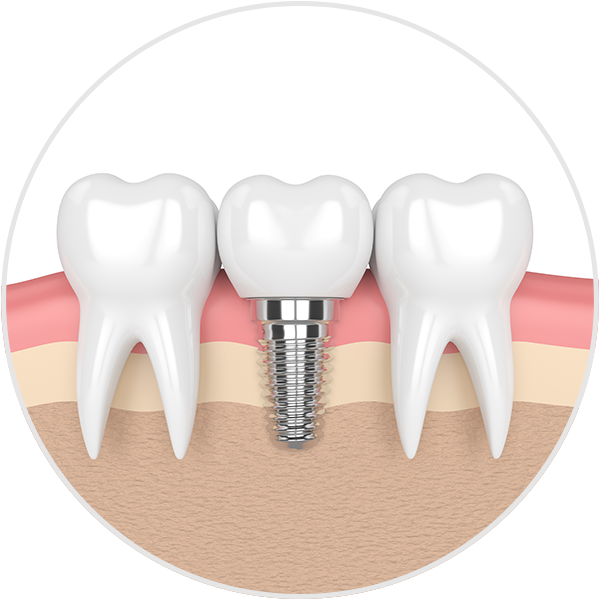
Dental implants are designed to provide a foundation for replacement teeth that look, feel and function like natural teeth. The person who has lost teeth regains the ability to eat virtually anything and can smile with confidence, knowing that teeth appear natural and that facial contours will be preserved. The implants are tiny titanium posts which are placed into the jaw bone where teeth are missing. The bone bonds with the titanium, creating a strong foundation for artificial teeth. In addition, dental implants can help preserve facial structure, preventing the bone deterioration which occurs when teeth are missing.
Dental implants are changing the way people live! With them, people are rediscovering the comfort and confidence to eat, speak, laugh and enjoy life.
Evaluation for Dental Implants
If, like many others, you feel implant dentistry is the choice for you, we ask that you undergo a dental/radiographic examination and health history. During these consultation visits, your specific needs and considerations will be addressed by an Oral and Maxillofacial Surgeon referred by our practice. Your questions and concerns are important to us and our team will work with you very closely to help make your procedure a success.
Surgical Advances in Dental Implants
Using the most recent advances in dental implant technology, Dr. Rhyne works with Oral and Maxillofacial surgeons to have single stage implants placed most often. These implants do not require a second procedure to uncover them, but do require a minimum of three months of healing time before artificial teeth are placed. There are even situations where the implant can be placed at the same time as the tooth extraction – further minimizing your number of surgical procedures. There are circumstances that require treatment to be phased into several procedures depending on bone quality and other factors that will be discussed at your initial consult.
Dental Implant Procedure
Dental implants are metal anchors, which act as tooth root substitutes. They are surgically placed into the jaw bone. Small posts (abutments) are then attached to the implant, which protrude through the gums. These abutments provide stable anchors for artificial replacement teeth.
After the dental implant has bonded to the jaw bone, Dr. Rhyne can then start making your new tooth. An impression or intraoral scan must be made. Then posts or attachments can be connected to the implants. The replacement teeth are then made over the posts or attachments. The entire procedure usually takes six to eight months, and most patients do not experience any disruption in their daily life.